 5 pages · PDF
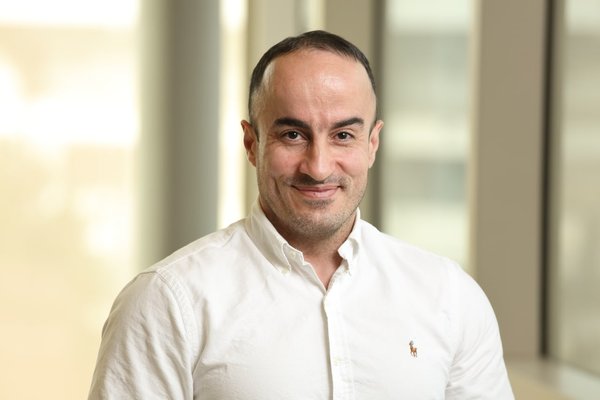
Farzad Shafiei Dizaji
Mathematics / Civil (Structural) Engineering Educator
Former Lecturer Professor, University of Virginia · 2019 – 2026
28-story steel building with SMA re-centering dampers · from my research
Mathematics / Civil (Structural) Engineering educator
Farzad Shafiei Dizaji
For seven years I taught calculus, differential equations, linear algebra, and probability to engineering students as a Lecturer at the University of Virginia. I am seeking lecturer and assistant professor positions in mathematics and civil engineering.
- Calculus I–III
- ODE
- Linear algebra
- Probability & statistics

 AboutAbout me
 PhilosophyHow I teach
 TeachingCourses taught
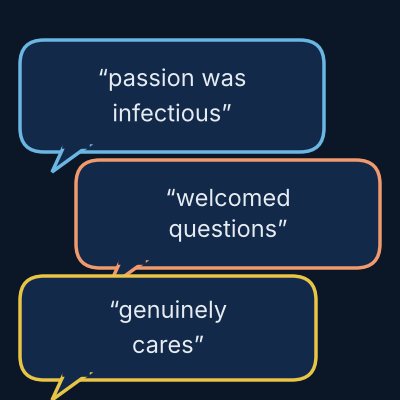 StudentsIn their words
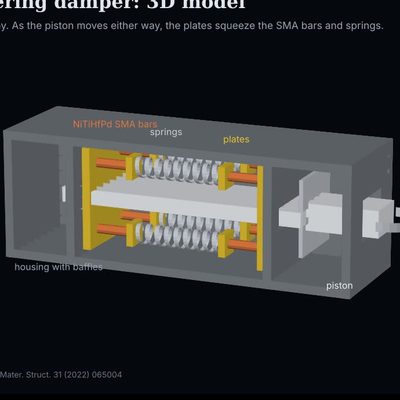 ResearchDampers, graphs
 PublicationsPapers
 ContactGet in touch
For search committees
Ready to teach · Mathematics
Calculus I–III, Differential Equations, Linear Algebra, Probability & Statistics, Engineering Mathematics, PDE, Numerical Methods, precalculus and STEM-skills courses
Ready to teach · Civil engineering
Statics, Mechanics of Materials, Structural Analysis, Steel and Reinforced Concrete Design, Structural Dynamics; electives in earthquake engineering, FEM and smart structures
Experience
Seven academic years as a full-time Lecturer at UVA (Fall 2019 – Spring 2026), 1,100+ engineering students; structural engineering practice 2009 – 2015; 18 publications
Degrees & availability
M.Sc. Structural Engineering (UVA), M.Sc. Earthquake Engineering (IUST). Available for positions starting Spring 2027.
CVTeaching statementResearch statementDiversity statementAll résumésContact
News
- Applying for lecturer and assistant professor positions in mathematics and civil engineering, starting Spring or Fall 2027.
- New on this site: a teaching statement, a teaching introduction video and interactive versions of my research models.
- Completed seven academic years as a Lecturer in UVA's Applied Mathematics Center (Fall 2019 – Spring 2026).
- Co-authored ASEE paper Exploring the Impact of Mastery Grading on Student Performance.
About
I trained as a structural engineer and became a mathematics instructor. I hold M.Sc. degrees in Civil (Structural) Engineering from the University of Virginia and in Civil (Earthquake) Engineering from Iran University of Science and Technology. Both theses lean on applied mathematics: one on seismic control devices, the other on graph-theoretical optimization of structural matrices.
From Fall 2019 through Spring 2026 I taught undergraduate mathematics as a Lecturer in the Applied Mathematics Center at the University of Virginia. That appointment ended with the Spring 2026 semester. I am seeking teaching and research positions in mathematics and engineering.
- Taught at UVA
- 2019–2026
- Sections
- 20+
- Class sizes
- 14 to 140+
- Students taught
- 1,100+
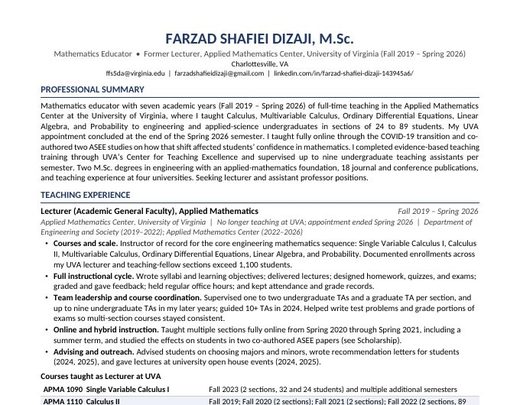
CV & résumés
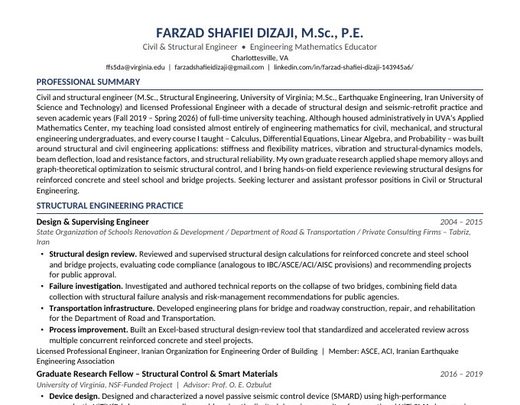
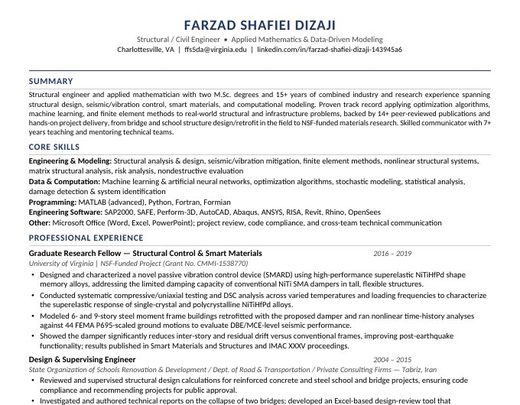
Choose the document that fits the role. The CV is the complete academic record; each résumé is tailored to a type of position.
Teaching philosophy
Students rarely fail to learn mathematics because they lack the capacity for it; they disengage from it because they cannot see why it matters to them.
My goal in every course I teach is to close that gap: to make the mathematics rigorous, but also visibly and repeatedly relevant to the discipline each student came to study. My own research on engineering students at UVA sharpened this view. Our data showed that many capable students carry real anxiety about their mathematical ability, and that it shapes their academic choices. Confidence-building is not a soft add-on to rigorous instruction; it is a prerequisite for it.
Mathematics in context
I frame each topic around the problems students will use it to solve: modeling dynamic systems with differential equations, analyzing uncertainty with probability and statistics, and applying linear algebra to structural and computational problems.
Active, not passive
Trained through UVA's Center for Teaching Excellence, I replace passive lecture time with structured problem-solving and inquiry-based activities, so students discover ideas while help is in the room.
Low stakes first
Early assessments are diagnostic and low-stakes, so misconceptions surface before they compound and students see where they stand.
Office hours without embarrassment
I make office hours a low-pressure space to ask foundational questions, because the students who most need help are often the least comfortable asking for it.
Teaching
University of Virginia, Applied Mathematics Center
I taught more than twenty sections across the first- and second-year mathematics sequence and supervised undergraduate teaching assistants (up to nine at a time) along with graduate assistants in several sections.
How I teach: two evidence-based methods
Ordinary Differential Equations
Inquiry-based (discovery) learning
In ODE I use an inquiry-based approach in which students discover the material themselves: they work through carefully sequenced problems, make conjectures and build the methods before the formal treatment. The approach comes from an NSF-funded project and has been used in UVA's Applied Mathematics Center for the last six years. It has proved highly effective, and students really like it.
Calculus I · Probability
Mastery-based grading
In Calculus I and Probability I used a mastery grading system, in which students show mastery of each core skill and grades reflect what they have learned. It was effective for most of the class. My co-authored ASEE 2024 study, Exploring the Impact of Mastery Grading on Student Performance, examines this approach.
Mastery grading study (PDF) · ASEE 2024
| Course | Number | Level |
|---|---|---|
| Single Variable Calculus IMastery grading | APMA 1090 | First year |
| Single Variable Calculus II | APMA 1110 | First year |
| A Survey of Calculus II | MATH 1220 | First year |
| Multivariable Calculus | APMA 2120 | Second year |
| Ordinary Differential EquationsInquiry-based | APMA 2130 | Second year |
| Linear Algebra | APMA 3080 | Upper level |
| Introduction to ProbabilityMastery grading | APMA 3100 | Upper level |
| Applied Statistics and Probability | APMA 3110 | Upper level |
Course materials
Sample syllabi and worksheets from courses I taught at UVA.
Ordinary Differential Equations
Inquiry-based course built around pre-class and in-class worksheets, with four midterms, written homework and a final.
How an inquiry-based ODE lesson runs
Each lesson is a pair of worksheets. Students meet the idea on their own before class, then build it with classmates during class, so class time goes to discovery and discussion rather than lecture.
Pre-class worksheet: think on your own→Check-in on the PCW→In-class worksheet in assigned groups→Class-wide discussion
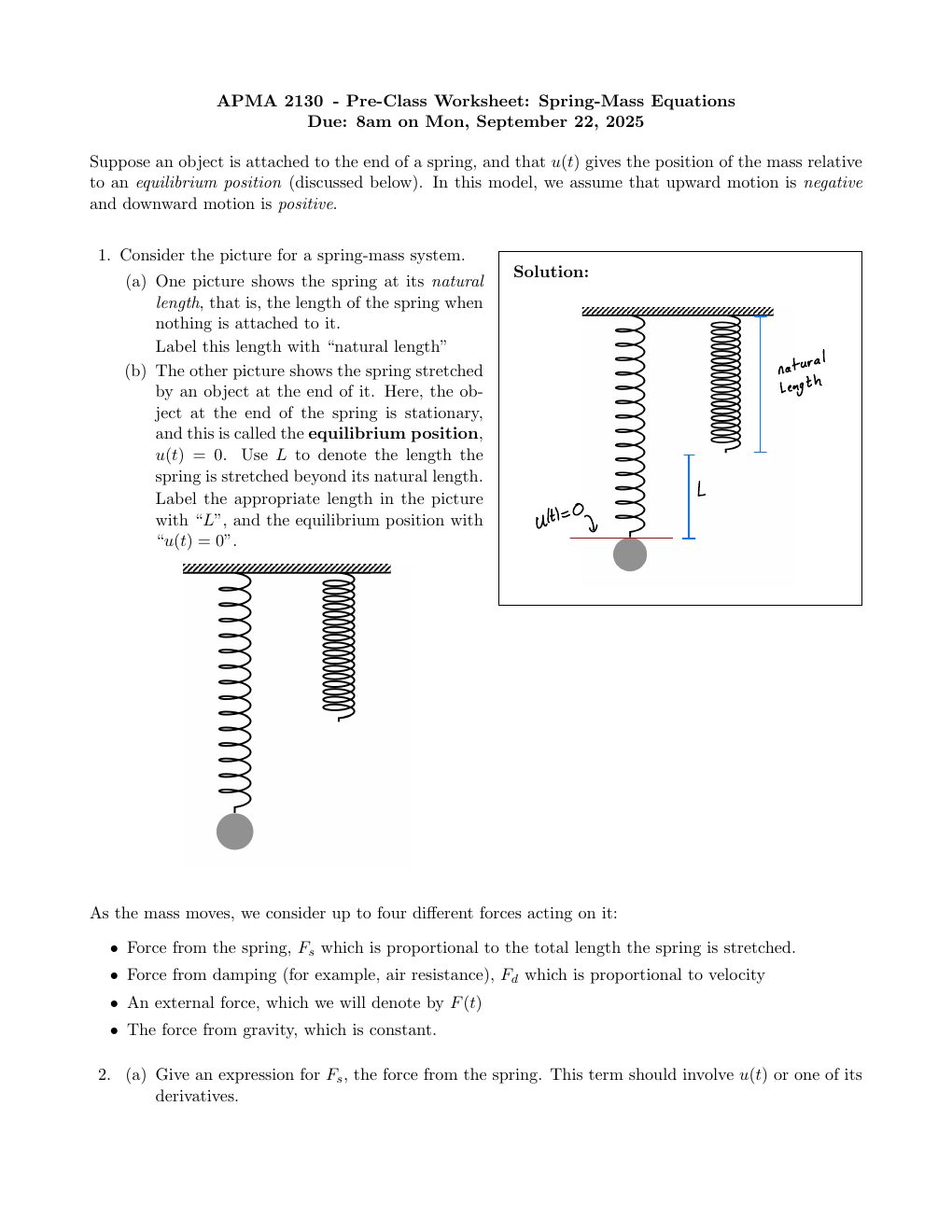
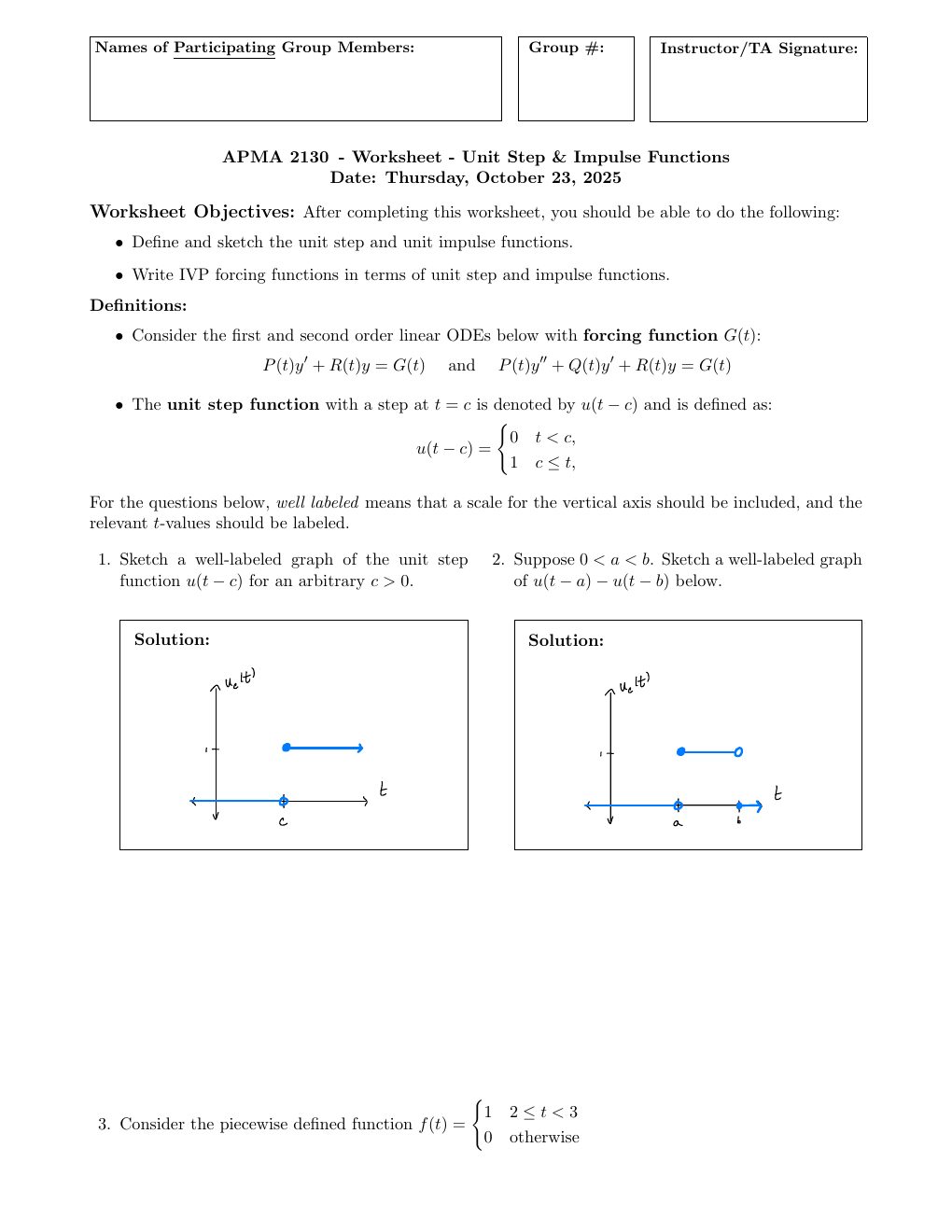
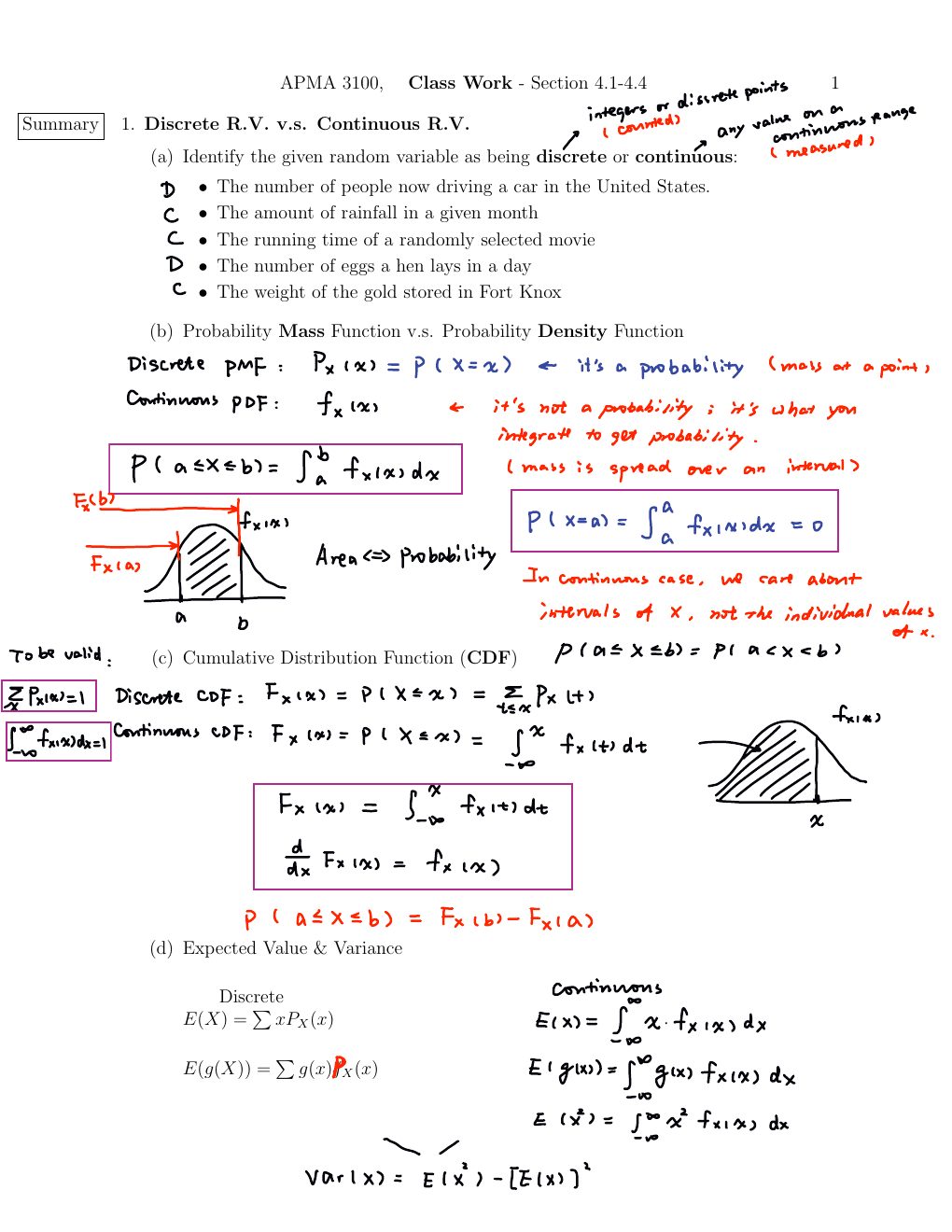
Each worksheet is shown with its solutions.
I taught fully online sections from Spring 2020 to Spring 2021, including a compressed Summer 2020 ODE section of 26 students.
Recognized by the Society of P.R.I., University of Virginia
The Society of P.R.I. recognized my work in the School of Engineering and the wider Charlottesville community, describing me as a key component to undergraduate success in the Applied Mathematics Departments, as well as a mentor to all of the students you impact.
The letter noted that your efforts have been especially important in the midst of the COVID-19 pandemic.
Teaching development
- Foundations of Scholarly Teaching (six-week program), UVA
- Active Learning Techniques for a More Engaged Engineering Class, UVA workshop
- Fellow, Tomorrow's Professor Today program, UVA
Earlier teaching
- Graduate Teaching Fellow, University of Virginia, 2017–2019: Statics, Strength of Materials, Partial Differential Equations, Multivariable Calculus (143 students), Engineering Mathematics, Probability and Linear Algebra.
- Graduate Teaching Fellow, University of Central Florida, 2015–2016: Statics (140 students), Structural Analysis laboratory, Reinforced Concrete Design, Structural Mechanics.
- Instructor, University of Maraghe and Islamic Azad University of Tabriz, 2011–2014: mechanics of materials, structural analysis, steel and concrete design.
Mentoring and course leadership
- Supervised up to nine undergraduate teaching assistants and a graduate teaching assistant in a single semester; guided 10+ TAs in 2024
- Helped write exams and grading rubrics for multi-section courses so every section was assessed consistently (2024, 2025)
- Advised students on majors and minors and wrote recommendation letters for graduate programs and engineering careers
- Gave lectures at university open house events (2024, 2025)
- Volunteer, BRIDGE summer program for students from underrepresented backgrounds, 2018
- Mentor, VA-NC Alliance for Minority Participation and Diversity summer research program, 2018
Graduate mathematics coursework
Stochastic Modeling, Numerical Analysis in Civil Engineering, Engineering Mathematics I and II, Nonlinear Structural Analysis (finite element method), Applied Statistics and Probability, Optimization using Graph Theory, and Partial Differential Equations. Transcripts are available on request.
What students say
He was always open to questions and discussions in class. One specific time I remember a student had found a different path to finding a solution to a problem, and Professor Dizaji allowed him to come write it on the board and share it with the class. He welcomed the student's new perspective and explained how it was an alternative method of solving the problem.
This was by far the best APMA I have taken so far. Professor Dizaji is a great guy and teacher and was always so willing to help.
Students in the class would correct him. Instead of denying it, he re-thought the problem and saw whether or not the student was correct and fixed his mistake. If the student was wrong, he wouldn't make them feel bad.
Through office hours he reassured me when I was scared about passing the class or not. He gave me more confidence and enthusiasm to study more.
Professor Dizaji was very kind and respectful to all students. He was always available for extra support and made sure no student was lost or confused.
Professor Dizaji was able to create an environment of welcomed diverse perspectives through his constant positive attitude and passion for calculus.
The instructor never critiqued a student for asking a particular question. I felt like he welcomed all levels of understanding and approach to solving these equations and never put anybody down.
The instructor encouraged different approaches to solving problems and treated every student's contribution with respect. This created a welcoming atmosphere where I felt comfortable asking for help.
In-class lectures were the biggest thing for this class and they were pretty helpful. Professor likes to usually prove whatever we are learning then go into some examples which is an effective way to teach in my opinion.
Professor Dizaji was easy to talk to and a kind personality in the classroom. He treated everyone with respect and treated even the most stupid questions with professionalism and respect, which made me feel welcomed in the class.
Professor Dizaji was amazing, and I really enjoyed the course!
I believe that your lectures were SUPER helpful to my learning in this class.
He never shut anyone down and always listened to students' thoughts respectfully, kindly correcting them when they were wrong.
Dizaji was a very good professor that helped elaborate on topics with a lot of detail 1 on 1.
I had an excellent time learning this course from my professor, and when topics were unclear, he helped in explaining further.
Professor Dizaji's class was a standout. His passion for the subject was infectious, breaking down complex topics with enthusiasm. He encouraged questions, provided engaging resources, and made learning a dynamic experience.
Professor Dizaji's class was amazing. His passion for the course material created an atmosphere where students were excited to learn. Moreover, Professor Dizaji is extremely knowledgeable about the course content and breaks down complex topics in a way anyone can understand.
When he would work a Math problem out on the board, he would often ask the students to guide him through the problem. This created an environment in which most students would actively participate as he would not be harsh towards an incorrect answer. Instead, he would kindly explain why a student is incorrect.
Professor Dizaji always welcomed questions and encouraged people to challenge his perspectives or correct him if he made any mistakes. He was very enthusiastic about participation and encouraging to have students answer questions and participate in lecture.
Going to Professor Dizaji's office hours as well as attending TA office hours greatly increased my knowledge on certain subject matters that had confusing or weirdly framed parts. After the sessions, I felt relatively more comfortable solving the problems on my own.
He is an excellent individual who genuinely cares about his students and their learning.
Math in motion
Research
Research statement (1 page)Download
Mathematics education for engineering students
With colleagues at UVA I published three studies at the ASEE Annual Conference. The first examined how remote instruction during COVID-19 affected students in applied mathematics courses for engineers. The second used a grading option to measure engineering students' confidence in mathematics. The third explored how mastery grading affects student performance. These findings shape how I structure my own courses.
COVID-19 study (PDF) · ASEE 2022 Math confidence study (PDF) · ASEE 2023 Mastery grading study (PDF) · ASEE 2024
Shape memory alloy dampers
My M.Sc. thesis at UVA, advised by Prof. O. E. Ozbulut, developed self-centering control devices that use shape memory alloys to reduce seismic response at several hazard levels. A related paper in Smart Materials and Structures (2022) studies steel frames upgraded with NiTiHfPd re-centering dampers.
Read the paper · Smart Materials and Structures SPIE 2022 paper (PDF)My M.S. thesis: interactive tourThesis PDF (UVA, 2019)
InteractiveWork the SMA re-centering damperExplore the interactive versionClose
Three ways to explore the SMARD: drive the piston yourself and watch the SMA bars and friction springs work, see how the NiTiHfPd alloy changes with temperature, or tune the device and compare its flag-shaped loop with each component on its own.
Tip: drag the piston rod left or right, then let go: the flag-shaped loop passes through zero, so the device pulls itself back to the center. Model: OpenSees self-centering elements for the SMA bars and the friction springs with the parameters in Table 4 of the paper (stroke ±150 mm).
| 25 °C | 5 °C | −35 °C |
|---|
Each bar is modelled as two self-centering materials in parallel (Figure 13a) with the parameters of Table 3 (initial stiffness, post-transformation stiffness, activation stress and β), fitted to compression tests at 1.0 Hz. Colder alloy gives a fatter loop: more energy dissipated per cycle.
Starts from Table 4: SMA k1 = 61.23 kN/mm, k2 = 13.80 kN/mm, Fa = 104.01 kN, β = 0.35; friction springs k1 = 28.75 kN/mm, k2 = 0.9677 kN/mm, Fa = 11.50 kN, β = 1.0. Equivalent damping ξeq = ED / (4π ES).
InteractiveShake the buildingExplore the interactive versionClose
Choose an earthquake strength and run it on a 9-story, 5-bay steel moment frame with or without SMA re-centering dampers. Watch the force–displacement loop and the drift left behind when the shaking stops.
Press “Start earthquake”.
Illustrative single-degree-of-freedom model with a synthetic ground motion: an elastic–plastic frame, plus a flag-shaped SMA device when the dampers are on. The frame is drawn as the 9-story, 5-bay building from the Smart Materials and Structures (2022) paper; the model shows the behaviour studied there, not its numbers.
Self-centering SMA braces
With F. Shi, G. P. Toker, O. E. Ozbulut and H. E. Karaca, I studied NiTi-based shape memory alloy braces for steel buildings (11th U.S. National Conference on Earthquake Engineering, 2018). The braces sit in a chevron layout in every bay of every story of a 4-story steel frame and work only in tension: as the building sways, one brace of each pair stretches and the other goes slack. Their superelastic, flag-shaped response dissipates energy and then pulls the building back to plumb. Under the strongest ground motions, the median residual drift fell from 4.31% for the moment frame to 0.69% with SMA braces, and the performance stayed nearly the same from −35 °C to 25 °C.
Read the paper (PDF) · 11NCEE 2018
Optimization with graph theory
My first M.Sc. thesis, advised by Prof. Ali Kaveh, proposed seven graph-theoretical algorithms for improving the conditioning of structural flexibility matrices. Five of them appear in Engineering Computations (2022). The algorithms choose which cycles of a frame's graph model are used in the force method. Short cycles make the flexibility matrix sparse; cycles chosen by member weight make it better conditioned, so round-off errors shrink. Sparsity and conditioning cannot both be optimized at once, so the problem is a multi-objective one.
Read the paper · Engineering Computations
InteractivePick a member, find its minimal cycleExplore the interactive versionClose
Drag to rotate the dome. Click any member: it is removed, a shortest route tree grows from one of its ends, and the moment the tree reaches the other end, the tree path plus the member is the minimal cycle.
96 nodes · 176 members · cycle basis M − N + 1 = 81. Click a member.
Neural networks for hysteresis
With M. Farrokh and M. Shafiei Dizaji, I developed the Extended Preisach Neural Network (EPNN), published in Neural Processing Letters (2022). Ordinary neural networks lack the memory needed to reproduce hysteresis, where the output depends on the path the input has taken. The EPNN has two hidden layers. Its deteriorating stop (DS) neurons each act like a spring pulling a block across a friction surface, which gives the network memory and lets loops degrade; its sigmoid neurons shape non-Masing and asymmetric loops; and an extra input for the rate ẋ(t) lets it learn rate-dependent hysteresis. Trained with a hybrid of a genetic algorithm and sub-gradient optimization, it agreed well with experimental hysteresis from ferromagnetic materials, magnetostrictive actuators and shape memory alloy actuators.
Read the paper · Neural Processing Letters
InteractiveExplore the hysteresis loops in the EPNN paperExplore the interactive versionClose
Pick a tab. The first one is a single NDS neuron (Eqs. 1–6 and Figure 5): change wx, wẋ and β and see which loops it can make. The others are the kinds of hysteresis from the paper's eight examples. Press Play, or drag the slider (or across the plot) to set the input yourself; in the rate-dependent tabs, dragging faster opens the loop wider.
The NDS neuron tab follows the paper's equations exactly. The other tabs reproduce the kind of loop in each example (symmetric or not, saturated, degrading, rate-dependent), built from the same neurons; they are illustrations, not the measured data or the trained networks from the paper.
Neural networks for dam–reservoir–foundation interaction
With A. Joghataie and M. Shafiei Dizaji, I built a "neuro-modeller" for Pine Flat concrete gravity dam (International Conference on Intelligent Computational Systems, ICICS'2012, Dubai). Nonlinear finite element analysis of a cracking dam that includes the reservoir and the foundation is slow. We trained a feed-forward network with 15 input nodes, 8 sigmoid hidden neurons and 2 output nodes on 20 seconds of the dam's response to a white-noise earthquake (1000 input–output pairs at 0.02 s). Its outputs, the crest displacement and velocity at the next time step, are fed back as inputs, which gives the network the memory it needs to follow hysteretic behaviour. Once trained, it reproduced the finite element response to El Centro, Taft and Corralitos records that it had never seen, in far less time.
Read the paper (PDF) · ICICS 2012
InteractiveTrain a neuro-modeller for Pine Flat DamExplore the interactive versionClose
Train the network yourself on a white-noise record, then let it predict the dam's crest displacement under earthquakes it has never seen, step by step, feeding its own output back as input.
Full-batch backpropagation (Adam) on the mean square error of 999 input–output pairs. Stop early and try the Predict tab to see what an under-trained network does. The network predicts the change over one time step, which it adds to the current displacement and velocity.
Illustrative stand-in for the NSAG-DRI finite element analysis: the dam's first mode (period 0.32 s, 5% damping) with a heel crack that opens past 0.7 cm and lowers the stiffness, then closes again. Records A–C are synthetic motions with different frequency content; the paper tested El Centro, Taft and Corralitos. Deformations are exaggerated.
Figure 9 of the paper: at each step only the new ground accelerations come from outside; the displacement and velocity the network predicted a moment ago are fed back as inputs. This "side memory" is what lets a static feed-forward network follow the dam's history.
Interests
- Smart structures
- Energy dissipation
- Structural optimization
- Machine learning
- Finite element methods
- Earthquake engineering
- Structural health monitoring
- System identification
Publications
- Exploring the Impact of Mastery Grading on Student Performance
Morris, Ma, Shafiei Dizaji. ASEE Annual Conference & Exposition, 2024. PDF - Exploiting a Grading Option to Measure Mathematics Confidence of Engineering Students
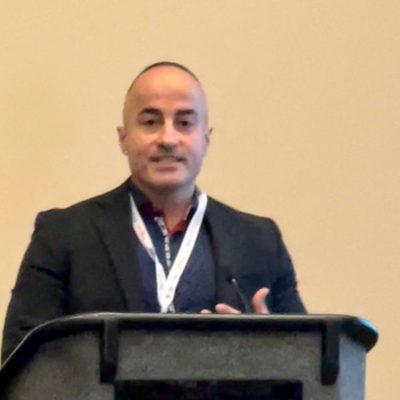
Guadagni, Maiti, Shafiei Dizaji. ASEE Annual Conference & Exposition, Baltimore, 2023. PDFPresenting this paper at the ASEE Annual Conference, Baltimore Convention Center, June 2023 - Impact of COVID-19 on Applied Mathematics Courses for Engineering Students
Guadagni, Maiti, Shafiei Dizaji. ASEE Annual Conference & Exposition, 2022. PDF - Seismic Performance Assessment of Steel Frames Upgraded with Shape Memory Alloy Re-centering Dampers Using High-Performance NiTiHfPd Material
Shafiei Dizaji, Shafiei Dizaji. Smart Materials and Structures 31, 065004, 2022. Publisher version - Novel computational mathematical algorithms for structural optimization using graph-theoretical methods
Shafiei Dizaji, Shafiei Dizaji. Engineering Computations 39(6), 2022. Publisher version - Hysteresis Identification Using Extended Preisach Neural Network
Farrokh, Shafiei Dizaji, Shafiei Dizaji. Neural Processing Letters, 2022. Publisher version - A novel passive structural control device using high-performance NiTiHfPd material
Shafiei Dizaji. SPIE Smart Structures + Nondestructive Evaluation, Proc. Vol. 12043, 2022. PDF - Experimental and Numerical Investigations on Seismic Applications of High Damping SMAs
Shi, Toker, Shafiei Dizaji, Ozbulut, Karaca. Eleventh U.S. National Conference on Earthquake Engineering, 2018. PDF - Neural Network Software for Dam-Reservoir-Foundation Interaction
Joghataie, Shafiei Dizaji, Shafiei Dizaji. International Conference on Intelligent Computational Systems (ICICS 2012), Dubai, 2012. PDF - Graph Theoretical Methods for Improving the Well-conditioning of Structures Flexibility Matrix
Shafiei Dizaji, Khanzadi. Journal of Civil Engineering, Ferdowsi University of Mashhad 22(1), 27–44, 2011.
Background
Education
| Degree | Institution | Years |
|---|---|---|
| M.Sc., Civil (Structural) Engineering, GPA 3.97 | University of Virginia | 2016–2019 |
| Graduate research, Civil Engineering, GPA 4.0 | University of Central Florida | 2015–2016 |
| M.Sc., Civil (Earthquake) Engineering | Iran University of Science and Technology | 2005–2008 |
| B.S., Civil Engineering | University of Tabriz | 2000–2005 |
Service
- Reviewer: Smart Materials and Structures, Journal of Intelligent Material Systems and Structures, Smart Structures and Systems
- Member: American Society of Civil Engineers, American Concrete Institute
- Vice President, ACI Student Chapter at UVA, 2018–2019
- Recognized for contributions to the UVA community by the Society of P.R.I., School of Engineering and Applied Science, 2020
Industry
Before graduate study in the United States, I worked for about a decade in Tabriz, Iran as a structural engineer. I supervised school renovation projects, designed and reviewed bridge and building structures, and wrote technical reports on two bridge collapses.
Beyond the classroom
Strength training is part of my weekly routine. It takes the same things I ask of my students: steady practice, patience with small gains, and showing up even on hard days.